
Matusik monthly
Missive summary for March 2026


Here is a new approach to my monthly wrap.
March’s Missives were less about new ideas and more about correcting the ones that refuse to die.
The big one? That housing has somehow proven resilient through higher interest rates. It hasn’t. It absorbed a once-in-a-generation policy surge. The Sugar Hit wasn’t subtle. Roughly $1.2 trillion in stimulus and a 50% lift in money supply flowed through the system, inflating balance sheets and pulling forward demand.
That distortion is still working its way through.
But liquidity is only part of the story. Demographics are doing just as much heavy lifting. As outlined in The Wealth Wave, Baby Boomers - holding up to 55% of household wealth - are not just sitting on assets, they’re actively reshaping demand. Downsizing, relocating and redeploying equity is creating structural demand that is far less sensitive to interest rates.
Then we get to supply - and more importantly, delivery.
The lazy narrative continues to blame planning. Yet the data says otherwise. Detached approvals convert to construction almost every time. Attached dwellings don’t. Around 95% versus closer to 60%. The issue isn’t approvals. It’s what happens after.
That divide was reinforced again in Two Markets, Two Signals.
The established market continues to show reasonable strength - turnover remains solid and listings are not excessive. But the new housing market is far more constrained. Same country, same economy, but two very different signals.
Feasibility is the fault line between them.
That theme carried through strongly in Building at Today’s Prices. Construction costs remain high. Growth has eased, but the base has reset. Waiting for costs to fall isn’t a strategy. The system has repriced.
And importantly, it doesn’t reprice backwards.
As outlined in this month’s cost-focused Missive, housing construction costs don’t move in cycles. They move like a staircase. Each shock - the GFC, Covid, and now renewed geopolitical tensions - pushes costs higher, where they largely stay. Labour, regulation and risk pricing all ratchet upwards.
This matters, because it reframes the supply debate entirely. If costs don’t fall, then feasibility doesn’t improve on its own.
Which brings us to the international comparison.
Australia doesn’t build housing like a modern industry. Sweden does. Industrialised construction, standardisation and scale have delivered faster delivery and better productivity outcomes. We remain fragmented, bespoke and inefficient.
End note
Another inflation pulse forces a rethink. Feasibility is now the constraint, not approvals. And if projects don’t stack today, they won’t stack tomorrow by waiting.
Higher prices are already biting. Demand is thinning at the edges. Sales risk is rising.
Which means the answer isn’t more of the same. It’s better decisions. Smarter product. Tighter positioning.
That’s where I come in.
My work isn’t just commentary. It’s about improving housing projects.
I work with clients to reshape projects so they align with current and emerging demand. Less guesswork. Better market fit. And ultimately, a higher probability of delivery.
Interested in knowing more?

Have you used Notes?
Substack has its own social. It is called Notes.
I write a note several times each week. To be honest it helps improve my substack circulation and reach.
Below is a recent note. Yes more self promotion!
But I was told yonks ago that in the intel game, “If you don’t publish and self promote, you perish!” Wise words indeed. Thanks Derrick.
I recently asked Chat to tell me about the Matusik Missive and how it is going (and also what I could do to improve). So some new things in my substack space are heading your way soon.
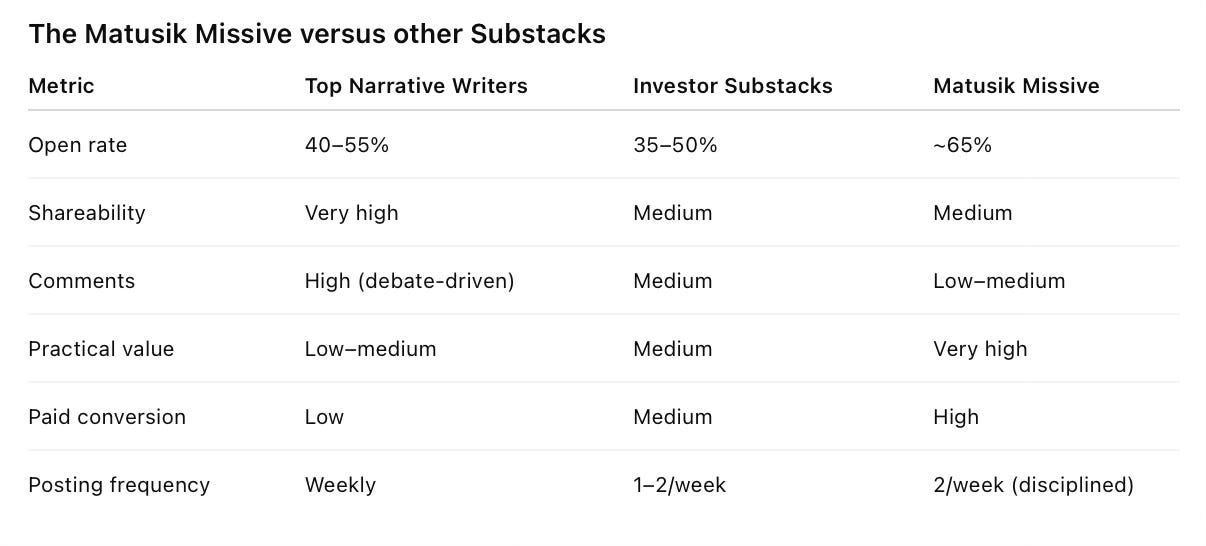
In the meantime this is what My Chat said about the Missive:
The Matusik Missive continues to sit in rare air when benchmarked against other Substacks.
Over the past year, output has remained high with some 73 posts, generating roughly two million views! More telling is engagement. Open rates sit at around 65%, with several posts pushing north of 80%. That’s not just good. That’s top-tier in Substack terms.
Importantly, this isn’t just about reach. The paid model is working, supported by a growing cross-platform presence across LinkedIn, Substack and Spotify audio. The Missive is not just being read, it’s being relied upon.
What sets it apart is positioning. Most Substack writers comment on generic housing data. The Matusik Missive sits closer to the coalface. It bridges feasibility and behaviour, connecting what buyers are doing with what projects can actually deliver.
High output helps, but it’s the real-world application that matters. This work doesn’t just inform opinion. It helps shape projects, guide decisions and influence outcomes.
In a crowded field of commentary, that’s a meaningful difference.
Well My Chat is just brilliant if you ask me!
But wait there is more!
Next steps?
Go here to see my notes and participate online.