
The wealth wave
Australia’s housing market is also being reshaped by the richest generation in its history


Following on from my post earlier this week, demographics are also having a major impact on housing demand and recent dwelling price appreciation across Australia.
Revisit

Synopsis
Baby Boomers, aged 62–80 in 2026, hold an estimated 45% – 55% of Australia’s household wealth and remain highly active buyers. As retirement accelerates, equity-rich households are reshaping housing demand nationally. The story behind recent price resilience isn’t just rates, migration or the sugar hits but also demography in motion.
Generations defined
Let’s start with the population structure. Baby Boomers, born 1946–1964, are now aged roughly 62 to 80 in 2026.
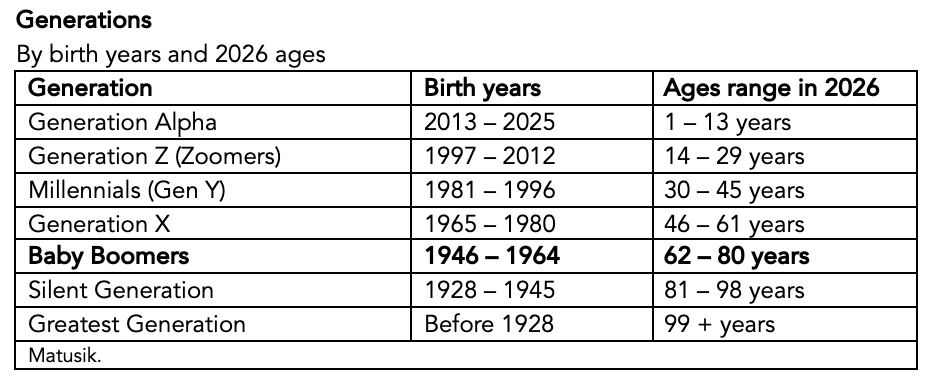
Australian generational size
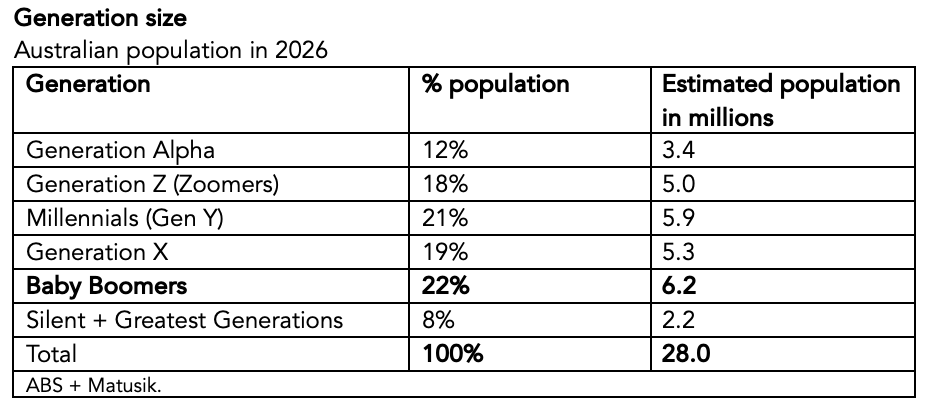
They represent just over one fifth of the population — about 5.9 million Australians. That alone is significant.
Now layer in wealth.
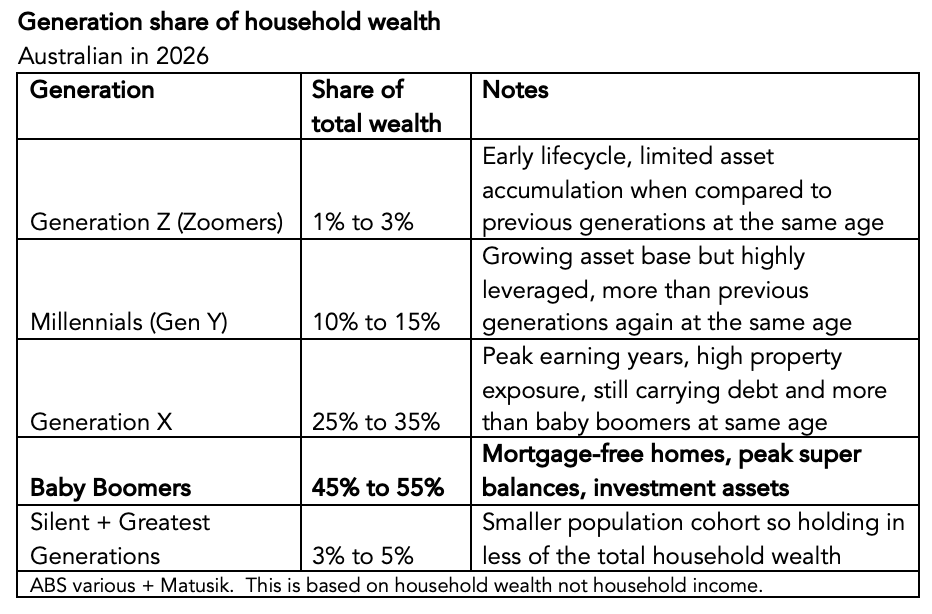
Boomers control an estimated 45% – 55% of Australia’s total household wealth. Not income. Not borrowing capacity. Wealth. That is decades of mortgage amortisation, capital growth and mature superannuation balances.
Generation X, aged 46–61, holds another 25% – 35%. Millennials, aged 30 – 45, hold perhaps 10% – 15%. Gen Z barely registers.
In other words, roughly three quarters of national wealth sits with Australians over 50.
Now consider transaction activity.
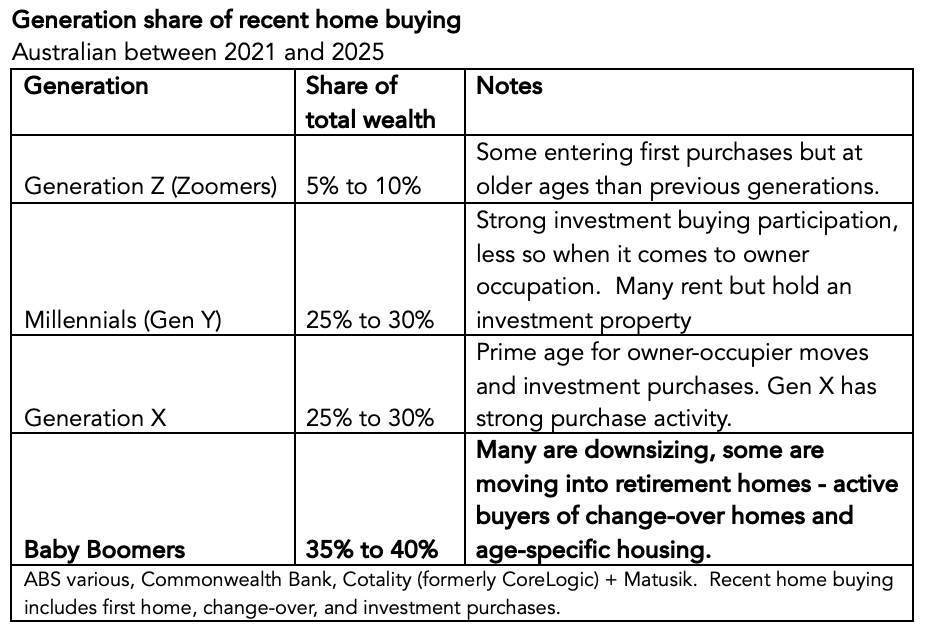
Over the past five years, Boomers have accounted for an estimated 35% - 40% of home purchases nationally. Gen X sits in a similar range. Millennials follow behind at roughly 25–30%, with Gen Z materially lower.
That means older cohorts are not only sitting on most of the wealth - they remain highly active in the housing market.
The impact
And here’s where my thesis bites. Boomers are not borrowing to buy. They are repositioning.
Retirement is not a moment; it is a multi-year process. It often involves selling the long-held family home, clearing residual debt, releasing equity and relocating - sometimes closer to family, sometimes toward lifestyle, sometimes into purpose-built product and communities.
The Gold Coast is the obvious example. It is the nation’s most visible retirement arbitrage market. A Sydney or Melbourne seller exits at $1.8–2.0 million and re-enters at $1.2–1.4 million. That is not a marginal transaction. That is purchasing power reshuffled. And it is largely insensitive to interest rate movements.
Nationally, a similar dynamic is playing out - coastal NSW, Sunshine Coast, parts of regional Victoria, lifestyle pockets of WA. The common thread is not tourism. It is ageing.
When a generation holding roughly half the nation’s wealth begins to transition en masse, it creates structural demand. Not speculative demand. Not stimulus-driven demand. Lifecycle demand.
You can see it in dwelling types too. Downsizing, low-maintenance homes, boutique apartments, land-lease communities, over-55 product. These segments are not being pushed by first-home buyers. They are being pulled by equity-rich retirees.
This helps explain why price growth has proven more resilient than many expected. Younger buyers are rate-sensitive and leveraged. Boomers are not.
Revisit


Listen
End note
The Australian housing debate is often framed as a youth affordability crisis versus investor greed.
The more accurate helicopter view is this: Australia’s housing market is being disproportionally reshaped by the largest, wealthiest generation in its history as it moves into retirement, and like a tennis ball moving through a garden hose, it is distorting the market’s shape.
The question is not whether this has lifted prices. It has, and more than many realise.
The real question is whether we fully appreciate that this demographic tailwind cannot last forever, and moreover, what happens when it eventually fades.
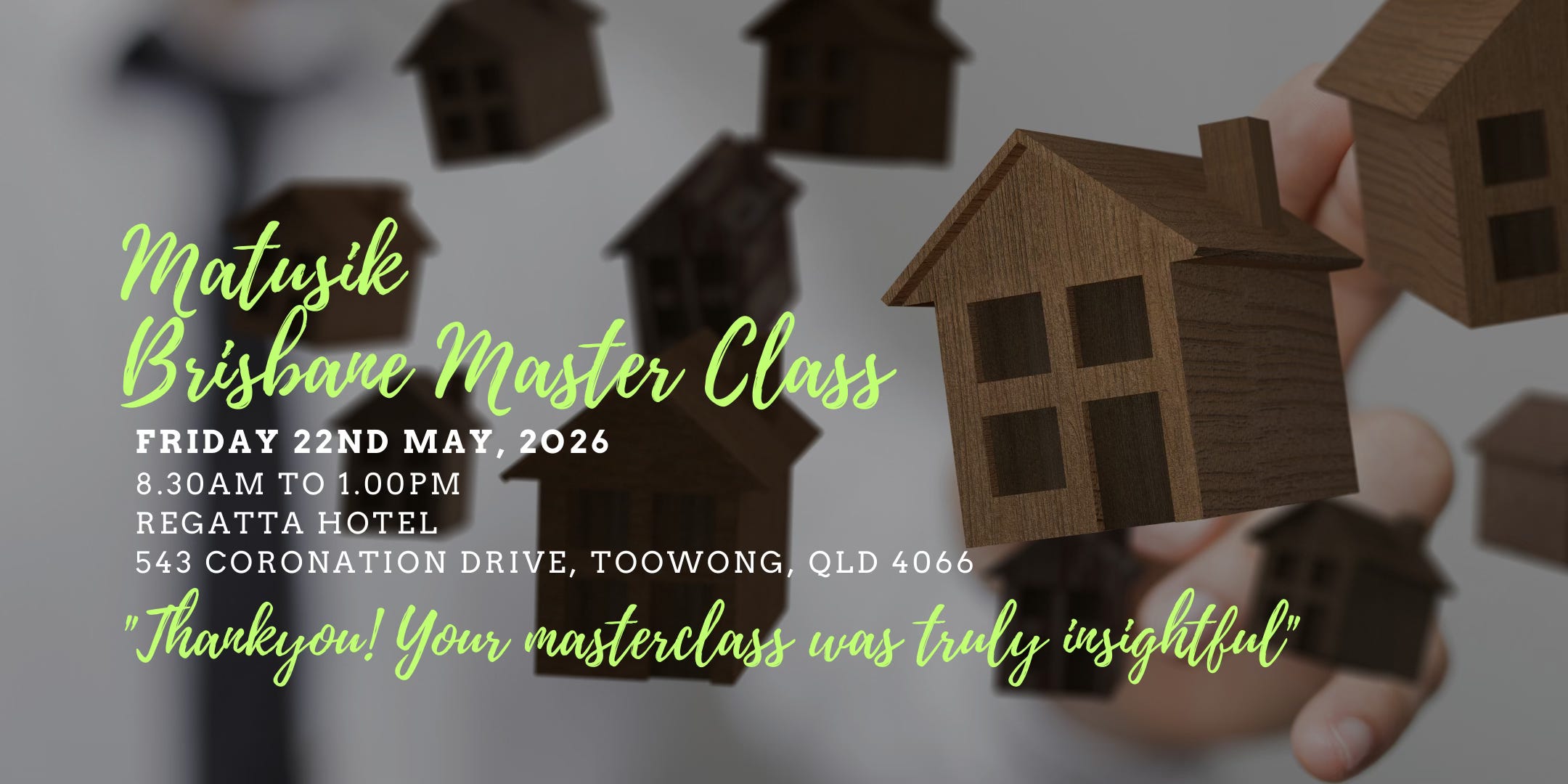
Just TWO seats remain.
My annual Housing Market Master Class is back - completely refreshed for 2026.
New data. New insights. New Four Square framework.
Four hours. Twenty-five seats. No fluff.
Brisbane | 22 May | $495 incl. GST | (Annual subscribers save 20%)
To book, email: office@matusik.com.au and include:
Your name/s
Number of tickets
Tax invoice details (7-day terms)
If you could ask me one question - what would it be?
Let’s make sense of where this market is heading - before it happens.
