
Budget Smudget
Free to all. And the first of three budget replies....


This post covers the proposed Local Infrastructure Fund and extended ban on foreign ownership of established homes across Australia. Both items were announced in the Federal Government’s Budget on May 12th 2026.
Local Infrastructure Fund
Australia’s new Local Infrastructure Fund sounds impressive at first glance. A $2 billion housing infrastructure package certainly makes for a good Budget headline. But spread over four years, it works out to around $500 million annually across the entire country. Then once administration costs across Canberra, the states, consultants, assessment frameworks and compliance processes are deducted, perhaps only $400 million actually reaches projects on the ground.
That’s not much money.
Not when one sewer upgrade can cost $100 million. Not when a single transport project can run into the billions. And certainly not when Australia needs around 240,000 new homes each year just to keep pace with population growth and existing housing shortages.
If the annual $500 million funding pool was distributed purely based on resident population, the split would look something like this:
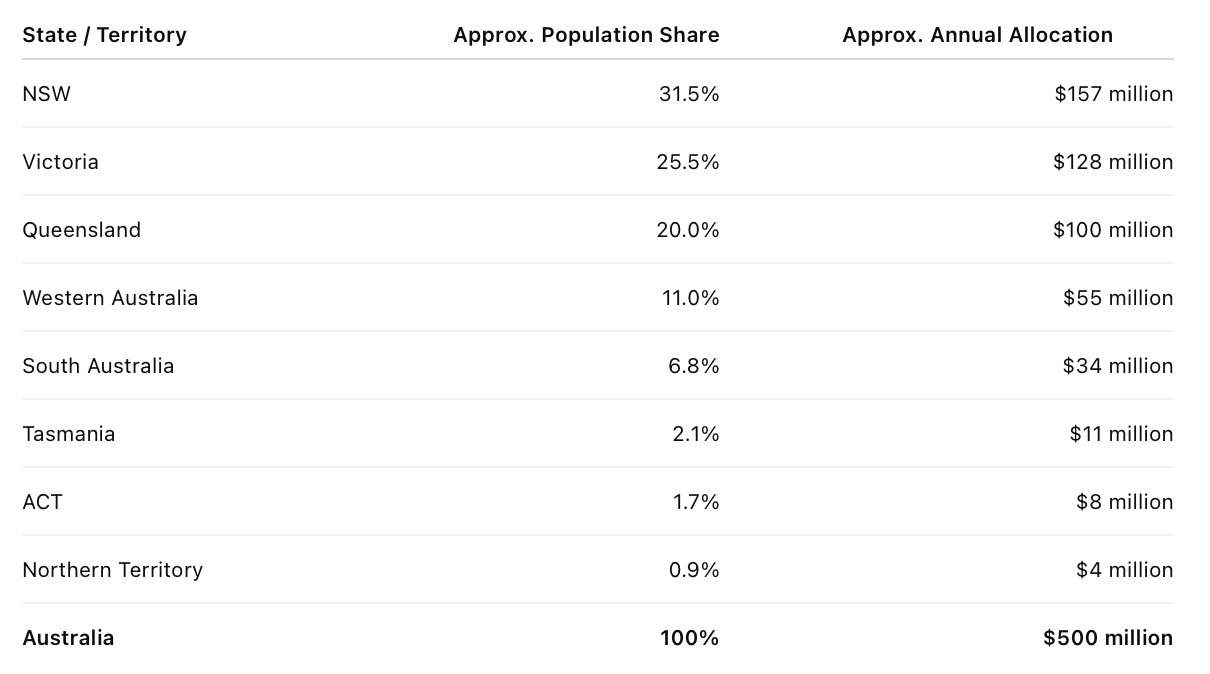
Now strip away perhaps 20% in administration costs and Queensland’s share alone likely falls from around $100 million annually to closer to $80 million. Useful, yes. Transformational, no.
And that is the bigger issue here. The Local Infrastructure Fund is poorly targeted. It doesn’t actually shape cities. It simply helps subsidise bits of infrastructure after growth pressures already exist. States bid for funding, Canberra assesses projects, money trickles out and infrastructure hopefully follows. Housing hopefully follows after that.
But nobody is truly coordinating transport, housing, jobs, planning and housing delivery together.
Which is why the old Building Better Cities Program from the late 1980s and early 1990s remains so relevant today. That program understood something modern housing policy seems to have forgotten: housing supply is really about city building. The Commonwealth directly partnered with state and local governments to reshape strategic urban precincts through integrated planning, infrastructure delivery and urban renewal. And importantly, it focused on where growth should occur.
In Brisbane, this helped transform places like Newstead, Tenerife and parts of New Farm from ageing industrial land into vibrant mixed-use urban neighbourhoods. Not just more dwellings, but entire urban environments with better public spaces, improved connectivity, more jobs and stronger transport integration. That is a very different proposition to today’s Local Infrastructure Fund.
Right now, Australia’s housing system is largely reactive. Infrastructure arrives after congestion. Transport follows population growth years later. Planning approvals can sometimes drag on. Communities resist density because the supporting amenity never arrives first. Meanwhile governments continue to spread funding thinly across hundreds of fragmented projects rather than concentrating investment where it can genuinely reshape housing supply outcomes.
For mine, Australia would be far better served by a modern version of Better Cities. Target perhaps half a dozen strategic precincts nationally. Fund them properly. Coordinate infrastructure upfront. Streamline approvals. Create genuine code-assessable development pathways. Ensure transport, housing and amenity are delivered together.
That would actually move the housing needle.
Because ultimately Australia’s housing problem is no longer simply about pipes and roads. It is about creating better cities where more people can live efficiently and affordably. The current Local Infrastructure Fund may help a bit around the edges, but it won’t materially reshape Australia’s housing future. We’ve done better city building before. We should do it again.
Or maybe something new could have been seeded. Something like modular home building. And at meaningful scale. The feds could use this $2billion ‘infrastructure’ spend to help start up a fund a range of modular home businesses across the country and importantly - at the same time - get the banks to start towing the line, meaning that they will lend, say 80%, on such builds. At present getting a loan in Australia for a prefab home is harder than a traditional build. Why?
Revisit

Foreign buying
The Federal Government’s decision in the May Budget to extend the ban on foreign investors buying established homes until mid-2029 sounds politically bold. But if we are genuinely serious about housing affordability, then for mine the policy still doesn’t go far enough. Australia should ban all non-Australian passport holders from purchasing residential property here. Not just established homes. All housing stock.
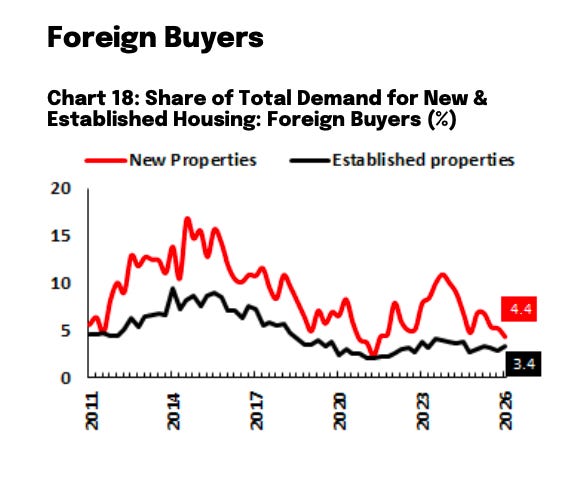
The official numbers suggest foreign buyers are only a modest part of the market. NAB’s latest residential property survey puts foreign buyers at around 4.4%% of new housing transactions and about 3.4% of established housing sales nationally.
It is interesting that although it is “legal” for overseas or foreign buyers to purchase an existing Aussie home, some 3% to 4% of our established dwellings are still ‘officially’ bought from folks with a overseas principal place of residence.
Moreover, anyone active in the market knows the real influence of offshore money is likely much larger than the formal statistics suggest.
Why? Because the official data only captures direct purchases by “foreign persons” under Australia’s foreign investment rules. It does not fully account for purchases through family members, trusts, local entities, proxy buyers or offshore-backed capital routed through domestic structures. Nor does it capture the behavioural impact foreign capital has on pricing expectations, especially across prestige housing, blue-chip school zones and selected apartment markets.
And this matters because housing is not just another asset class. Shelter is essential infrastructure. Yet we continue to allow global capital to compete against local wages in a market already suffering from chronic undersupply, slow approvals and inflated construction costs.
Critics argue a full ban would hurt apartment development because offshore pre-sales help secure finance. That is true to a point. But if Australian housing projects can only proceed by relying on overseas buyers competing with locals, then perhaps the delivery model itself is broken.
A full foreign buyer ban won’t solve Australia’s housing crisis on its own. But it would send a very clear message: Australian housing should primarily house Australians, not function as a global safety deposit box for international wealth.